
Eviction Notice Requirements
If you receive an eviction notice, make sure that it meets ALL the following notice requirements first! YOU DO NOT NEED TO LEAVE YOUR HOME IMMEDIATELY IF YOU RECEIVE AN EVICTION NOTICE.
If your landlord is attempting to evict you WITHOUT a court order (court order documents use words like “summons,” “complaint” and “unlawful detainer”), STAY IN YOUR HOME. All evictions must proceed through the courts. Following a court decision, the ONLY person that can physically remove you from your home is the sheriff, not the landlord.
NOTE: None of the following information serves as legal advice. All of the below information is for tenants in private residences in California, and is does not necessarily apply to tenants in subsidized housing.
1. Must be in writing.
If you were told to leave verbally or over the phone, that notice is NOT valid!
Fill out this Eviction Notice Invalid – By Phone or Verbal Sample Letter and give it to your landlord as soon as possible to let them know that you will continue to stay in your home!
2. Must be served in person or mailed and posted.
If you were told to leave over text, email, or any other form of electronic communication, that notice is NOT valid!
Fill out this Eviction Notice Invalid – Served by Text, Email or Other Electronic Message sample letter and give it to your landlord as soon as possible to let them know that you will continue to stay in your home!
3. Must have the proper notice time depending on the reason for the eviction.
If you are served a notice without the proper notice time below, the notice is NOT valid!
Fill out this Eviction Notice Invalid – Not Serviced With Proper Notice Time sample letter and give it to your landlord as soon as possible to let them know that you will continue to stay in your home!
Eviction Protections
CA Statewide Just Cause Eviction Protections
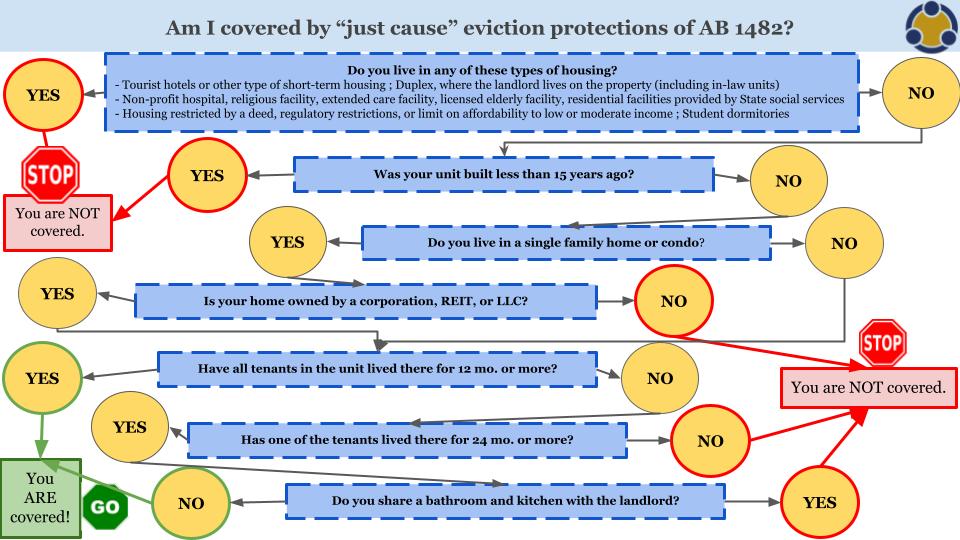
- SOME California tenants are covered by statewide just cause eviction protections. Just Cause eviction protections prevent unfair evictions by limiting the reasons your landlord can evict covered tenants. Landlords must state an allowable “just cause” reason on the written eviction notice to a tenant for it to be valid.
- Ask yourself these questions to find out if you are covered by statewide just cause protections!
Substantial Remodel Evictions
- The landlord can only evict if the remodeling work will:
- Replace a major system requiring a government permit or fix dangerous materials (like asbestos);
- The work will take at least 30 consecutive days;
- And the renter cannot safely live there
- On any days the renter can safely live in the home while remodeling the renter has the right to stay.
- The renter cannot be evicted for minor cosmetic repairs.
- The eviction notice must include a description of the work and an estimate of how long it will take. It must also include a copy of the permit(s) required for the work. If the work is to fix dangerous materials and does not require a permit, the notice can include a signed contract instead.
- If the repairs are not done, the renter has a right to return to the unit at the same rent and same terms. If the renter wants to move back in, the renter must tell the landlord and provide their address, the telephone nunber, and email address. The renter must tell the landlord if they accept within 30 days of receiving an offer to return, and move back in within 30 days of telling the landlord they accept.
Owner Move-In Evictions
- The landlord or their relative must move in within 90 days after the renter moves out and must live in the unit for at least 12 months. If they don’t the renter has a right to return to the unit at the same rent and same terms, and the landlord must pay the renter back for moving expenses.
- The eviction notice must state the name and relationship to the landlord of the person moving in, and if the renter requests proof that person qualifies, the landlord must provide it.
- Owner move-in eviction is limited to these family relations spouse, child, or grandparent.
- The renter cannot be evicted if the person moving in already lives on the property or if there is a similar empty unit available.
- Landlords may also be prohibited from doing owner move-in evictions depending on what the lease says, how they own the home, and what share of the home they own.
Discrimination, Harassment, Retaliation Reminders for Eviction Notices
- “Self-Help” Evictions where a landlord or master tenant, tries to move a tenant out without a court order, are CRIMINAL. Landlords and master tenants must follow a legal process in order to evict a tenant in California and CANNOT change the locks or throw out someone’s personal belongings without going through courts. If your landlord has tried to lock you out or remove your belongings, fill out our Lock Out Sample Letter to inform your landlord of your rights and turn it in it to the landlord.
- Retaliation by your landlord or master tenant is PROHIBITED.
- If a tenant asserts their rights to the landlord, such as the right to safe and sanitary housing, and a landlord attempts or threatens to evict, increase the rent or cause the tenant to leave within 180 days of the tenant having asserted their rights, the landlord is presumed to be retaliating against the tenant.
- Fill out our Retaliation Sample Letter to assert your rights against retaliation and provide it directly to the landlord.
- Discrimination is always PROHIBITED. Landlords are prohibited from evicting or threatening to evict you based on your race, color, national origin (ethnicity), religion, gender, marital status, familial status, disability, sexual orientation (FEHA), gender identity (FEHA), source of income, medical condition. Fair Housing Act Fair Employment & Housing Act Govt. Code 12900—Unruh Act, Civil Code 51, 54
- In this same way, discrimination because of your immigration status is PROHIBITED. If your landlord is threatening to call immigration officials on you or your family as a way to harass you to leave, fill out our Immigrant Status Threats Sample Letter and provide it to the landlord.
Fighting to Stay – We are Stronger Together!
Throughout California, we’ve seen people band together with their neighbors, community members, and loved ones to collectively fight their evictions! Time and time again, we see that this is the most effective way to build long-term stability and staying power. To learn more about how to talk to your neighbors, and organize to stay in your community check out our page on forming a tenants union.
Sample Letters
To assert your rights to landlord or master tenant, tailor these letters to your situation:
3-Day “Pay or Quit” Notice – Dispute due to Social Security Hardship
3-Day “Pay or Quit” Notice Invalid Renter Ledger
3-Day “Pay or Quit” or “Cure or Quit” Notice – Document Compliance to Stop Eviction
3-Day Eviction Notice – Dispute
Eviction Notice Invalid – By Phone or Verbal
Eviction Notice Invalid – Not Served With Proper Notice Time
Eviction Notice Invalid – Served by Text, Email or Other Electronic Message
Eviction Reason Invalid – No Just Cause Reason for Eviction
Eviction Reason Invalid – Pending Emergency Rental Assistance Program (ERAP) Application
Eviction Reason Invalid – Property Sale
Eviction Reason Invalid – Retaliatory for COVID-19 Rent Debt
Landlord No Fault Eviction Invalid – Relocation Assistance in 15 Days
Owner Move-In Eviction
Public Letter to Bank to Fight Eviction
Substantial Remodel Eviction Notice
Resources
Learn more about your protections and review these additional resources:
Am I covered by “just cause” eviction protections of AB1482?